
The Good Button Dilemma: To Press Or Not to Press?
But That's Not Really the Question

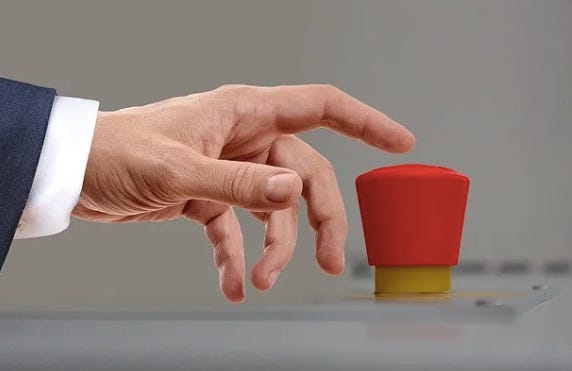
If something exists that possesses the seemingly incomprehensible power to compel man to walk away from the opportunity to acquire every possible earthly good he can imagine, in infinite quantity, what might that say about this something?
One of the most arduous decisions I deal with is what to listen to while working out at the gym. I don't often get a lot of time to listen to good podcasts or lectures, so it is vital that I choose wisely for that 45-min period of solitude! A few weeks back, I chose to listen to someone I had not listened to (or read) in awhile: Dr. David Berlinski, mathematician and philosopher at the Discovery Institute. Bench presses, squats, and Berlinski—why not?!
Berlinksi opened his lecture by discussing the good button dilemma. A button is positioned on a table, and the person who presses that button can have “anything you want...anything. Untold riches, the love of beautiful women, inexhaustible power, anything you want.” Then, Berlinski proceeded to posit the dreaded stipulation: “10,000 miles away in China, a peasant will drop dead in his tracks. You will cause his death.” You may receive all you ever dreamed of, but in an instant, you end another's potential to dream by removing him or her from this earth. Quite the conundrum, but something is indeed glaring about it.
In doing a quick, unscholarly glance online at some surveys and articles that posed the question of whether or not one might push the button, results yielded heterogenous responses. Some, with reasons that prima facie could be convincing, claimed, “Yes, I would.” Others, replied with indignation, “Absolutely not!” I recently posed this dilemma to my 7th grade students. Results of the class mirrored the online responses. Yet, as I pondered this dilemma, something came to mind.
In his Summa Theologica, Aquinas wrote about the inclinations of human beings to pursue happiness in these forms: wealth, pleasure, power, and honor. Man is naturally drawn to these instruments of purported happiness. (All it takes is a brief encounter on social media to witness the patent credibility of such a statement.) In the eyes of many across the ages, the acquisition of happiness by way of these four conduits is the embodiment of the highest good.
So here is where I got to thinking, if the simple push of a button could unleash to the presser a continuous flow of these four instruments of happiness, that for which man perpetually yearns, how inexplicably powerful must be that which restrains the hand? Does it really matter if someone you've never met and probably never will meet perishes at the cost of your greatest pursuit? For many, the answer is a definitive, “Yes!” The very fact that some would refuse to press the button warrants inquiry into the restrainer.
Berlinski: “What compels us not to press the button? . . . There is some compulsive force at work that we all recognize but cannot name.” Well, Dr. Berlinski, whatever it is, it is forceful enough to have many deny themselves and honor the life of a stranger. It is forceful enough to have many turn and walk away dejectedly from that which they had exalted as the highest good. It is even forceful enough to circumvent deliberation and instead prick the instinct. “I don't even need to think about this. The answer is, 'No!'” cries the subconscious. Lastly, it is forceful enough to render the four conduits to happiness as less than the highest good. If happiness via any or all of these is man's ultimate pursuit, it doesn't quite follow that in the eyes of man a higher good exists. Though if they were the highest good, and they were offered freely without limit, a rejection of them would imply that a higher good exists. Perhaps it is this compulsive force of which Berlinski speaks.
For the conscious dilemma-solver and the subconscious rejecter, both fundamentally (wittingly and unwittingly) argue the same: “It is good that I do not press the button.” Or, even for the one who struggles tremendously with the decision, “It is ultimately good that I do not acquire the highest good—my happiness.” No logical problem there! Something of the “It is good...” rationalization here resonates with the question asked by Christ in Mark 8:36: “For what does it profit a man to gain the whole world and forfeit his soul?” For the one who chooses to press the proverbial button and devotes his life to the pursuit of his own happiness, a peasant in China might not necessarily die, but what the “button-presser” doesn't know is that he pressed the detonator on his own life. He has forfeited his soul.
But I believe the most intriguing question to be this: for the one who does not believe in Christ, yet still doesn't press the button, what does it profit him to gain his soul and forfeit the whole world? How is it good in his eyes to surrender to some “compulsive force” so as to resist an avalanche of all the world has to offer?
The higher good to which he surrenders is not a religious good (for he is not religious)—it is a universal good. It is the highest good for all mankind. It is the good that transcends the human soul—for the human who chooses the button looks only within his own soul. “I desire all of this for myself!” Yet, the human, tantalized by the possibility of gaining the world but gazes at the button and says, “No,” is looking beyond his own soul. “Not mine, but yours” he doesn't necessarily say, but his mode of surrender to preserving a stranger's life is an emphatic bowing of the knee to that which lies beyond himself. This is the person who claims, “To gain all of this would be so good for me, but to reject it to save a life, well, that is just good.” Oh, he undeniably might not be thrilled to make this decision, which thereby renders this good to which he surrenders that much more powerful. A good that doesn't make one happy? Do we find there an oxymoron? Our world might say, yes. Consider, if this higher good exists, one that is powerful enough to compel a man to suppress his desire for the normative conceptualization of the good, might it be superior to mere happiness?Then the question that follows: wouldn't the pursuit of that higher good be most reasonable?
When this dilemma is presented, the listener is put in the place of the one with the opportunity to press the button. Let's adjust the scenario for a second. What if I were that peasant? What if years later, I was somehow made aware that I would have been the one to drop dead at the push of a button? To go further, what if I then found the man who said “No” to the button—the man who gave up all so that I could live? Now, what if I told you that a Man did this for me? For you?
One must consider that this higher good discussed above did not emerge ex nihilo—no thing does! Perhaps the Source of this compulsive force is the One who sacrificed even more, say, His life, so that we all might live? If true, then He ought to be the One to whom we ultimately surrender. He, Himself, must be the highest Good, whether we desire Him or not. He transcends us, but strangely enough, He dwells among us.
The compulsive force of which Berlinski speaks is intimately related to the highest good, for the highest good is intimately related to sacrifice. That which compelled this Man to not press the button on humanity, is love—sacrificial love. Is there a good that is higher? If you were that Chinese peasant who just found out that your life had been spared, I doubt you would think so. In fact, I think you'd like to meet this man, even really get to know him...